
Welding Fumes: Why a Clean TIG Arc Still Needs Extraction
TIG can fool you because the puddle is clean, there’s no flux burning off, and you aren’t standing in a cloud of smoke. You can run a nice bead on 304L stainless and still breathe contaminants you can’t see. That clear space between your hood and the work isn’t proof of clean air.
The hidden dangers of welding fumes come from the metal, the filler, surface contamination, and gases created around the arc. Shielding and purge gases add another hazard entirely. Here’s how to separate those problems and protect yourself without wrecking your gas coverage.
1. Low-Fume TIG Welding Isn’t Fume-Free Welding
TIG generally produces less particulate fume than stick or flux-cored welding, but “less” doesn’t tell you whether your breathing-zone exposure is acceptable. Welding fume consists of very fine particles formed when vaporized material cools and condenses. Some reach deep into your lungs, and a visible smoke cloud isn’t required for exposure. Meanwhile, gases such as ozone don’t show up as smoke at all.
Consider two ordinary jobs: a 1/16-inch stainless joint at roughly 40–80 amps DCEN and a 1/8-inch aluminum joint at roughly 120–180 amps AC. Those are illustrative working ranges, not safety thresholds, and actual settings depend on joint design and travel speed. The stainless job raises concerns about chromium and nickel compounds; the aluminum job can create a significant ozone problem. Neither becomes safe just because the finished bead looks good.
Your position matters, too. Lean directly over a joint inside a fabricated box and you put your nose in the path contaminants take as they rise. I’d rather reposition the assembly or change my viewing angle than spend an afternoon with my head over the plume. A welding helmet protects against arc radiation and certain physical hazards; an ordinary helmet does not filter your breathing air.
2. Identify the Metal, Coating, and Cleaner Before Striking an Arc
The base metal isn’t the whole exposure story. Filler wire, plating, paint, cutting fluids, and cleaning products can change what comes off the joint. Read the relevant safety data sheets and identify unknown material before welding it. “Looks like mild steel” is not much of a hazard assessment.
- Stainless steel: Welding can generate hexavalent chromium and nickel-containing fume. Low-carbon grades such as 304L and 316L are not low-hazard substitutes.
- Carbon steel and filler: Iron oxide is common, but manganese in the steel or filler also matters. Long-term manganese exposure can harm the nervous system.
- Galvanized steel: Heating zinc coatings produces zinc oxide fume, which can cause metal fume fever. Removing the coating creates its own dust-control problem.
- Painted or plated parts: Older coatings may contain lead, and cadmium plating presents a particularly serious inhalation hazard. Stop until the coating is positively identified and controlled.
- Specialty alloys: Beryllium-containing copper and other unusual alloys require specific precautions. Don’t treat every copper-colored component as ordinary copper.
Chlorinated cleaners don’t belong near arc welding
Arc ultraviolet radiation and heat can break down chlorinated solvent vapors into highly toxic gases, including phosgene. Some brake-cleaning and degreasing products contain these solvents, so check the ingredients rather than trusting the product name. Keep them and their vapors out of the welding area, including nearby cleaning operations. A part appearing dry is not an adequate safety check.
Use a cleaning method approved for the material and task, and manage the cleaner’s own fire and exposure hazards. “Nonchlorinated” does not mean harmless or nonflammable. Clean, clean, clean—but know what you’re cleaning with.
3. Understand the Damage: Irritation, Metal Fume Fever, and Cancer
Welding-fume exposure can produce immediate symptoms or cause damage that develops over years. Eye and throat irritation, coughing, chest tightness, and breathing difficulty are warning signs, not normal costs of getting the job done. Metal fume fever commonly brings flu-like symptoms several hours after exposure to certain metal oxide fumes, especially zinc oxide. Don’t assume fever after welding is merely a cold—or automatically diagnose it as metal fume fever.
The International Agency for Research on Cancer classifies welding fumes as carcinogenic to humans, with sufficient evidence that they cause lung cancer. That classification isn’t restricted to stainless welding. Some welding contaminants can also contribute to occupational asthma, chronic lung disease, or neurological harm. Low visible fume is a poor reason to accept repeated exposure.
For a concrete benchmark, the U.S. OSHA permissible exposure limit for hexavalent chromium is 5 micrograms per cubic meter as an eight-hour time-weighted average. That is a contaminant-specific limit, not an allowance for all welding fume combined. Other substances have their own limits, and legal compliance doesn’t mean zero health risk. You need appropriate air sampling to know where a particular operation stands.
4. Capture Welding Fumes Without Stripping Your Shielding Gas
Local exhaust ventilation captures contaminants near the source, before they pass through your breathing zone. An open roll-up door or pedestal fan may dilute contamination, but neither guarantees that clean air reaches your face. A fan behind you can also push the plume toward the welder at the next table. Moving the problem isn’t fixing it.
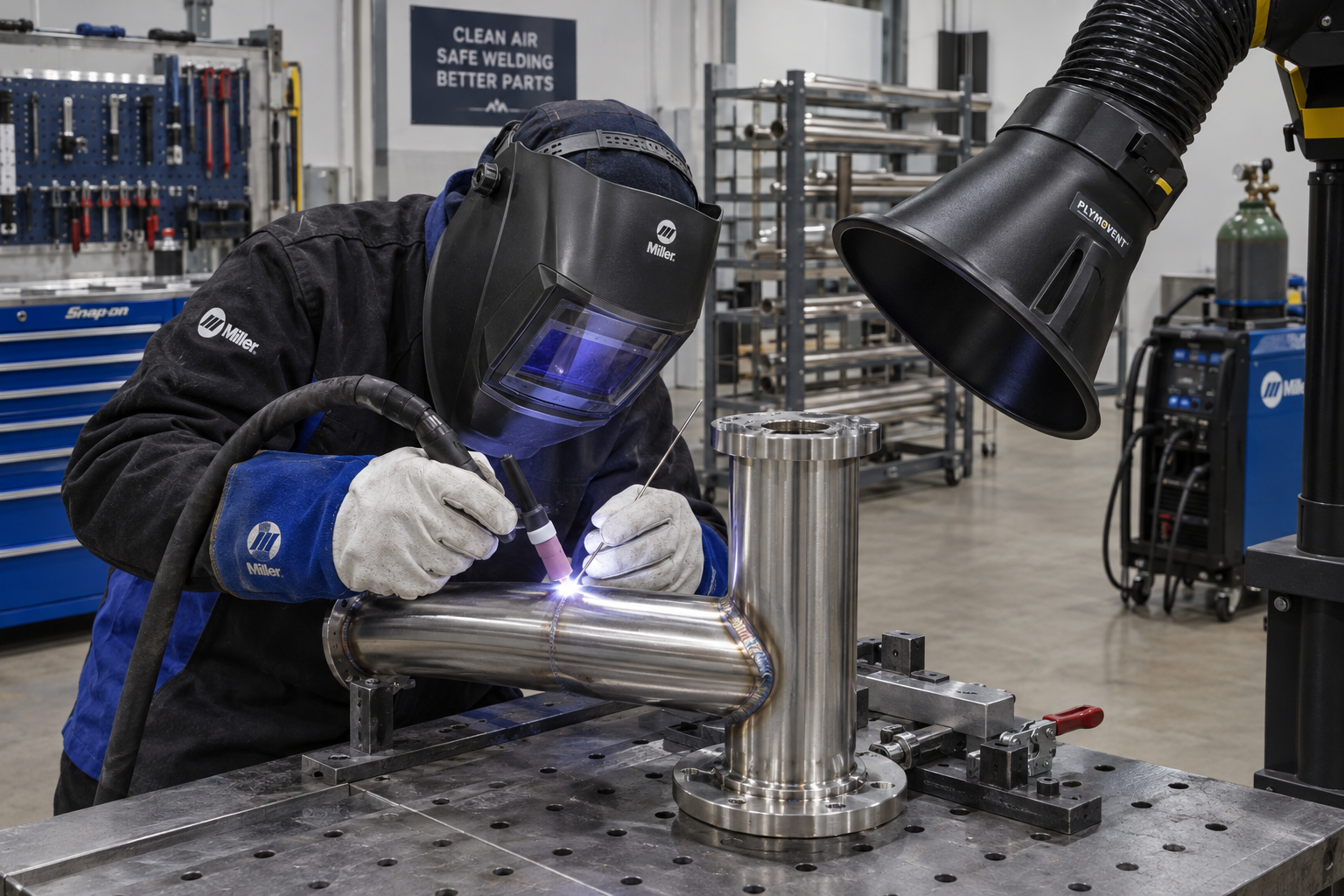
Place the extraction hood close enough to capture the plume, following the equipment’s operating instructions and the ventilation assessment. A movable hood several feet away may accomplish very little, even when the fan sounds impressive. Capture effectiveness falls quickly as the hood moves away, so reposition it as the weld progresses. Provide suitable replacement air so the exhaust system can actually move its intended airflow.
Check capture and weld quality separately
Too much crossflow at the cup can disturb shielding and cause oxidation or porosity. For many ordinary TIG setups, argon flow around 15–20 CFH is a reasonable starting range, but cup size, gas lens, joint geometry, and drafts all matter. Cranking the flowmeter up to fight extraction can create turbulence and waste gas. Correct the hood placement or airflow arrangement instead.
- Keep your head out of the path between the joint and extraction hood.
- Have capture verified using suitable airflow measurements or professional visualization methods; don’t spray improvised smoke or chemicals near the arc.
- Check filter condition, duct damage, and airflow indicators regularly.
- Confirm whether the system exhausts outdoors or recirculates air. A particulate filter alone does not remove ozone or other gases.
5. Choose Respiratory Protection for the Actual Contaminants
A respirator is not a substitute for making ventilation work, but it may be needed where engineering controls cannot adequately control exposure. Selection starts with the substances present, their concentrations, and the protection required. A disposable dust mask chosen because it fits under your hood is not a complete plan. Neither is buying the most expensive powered unit and assuming you’re covered.
- Particulate filters: A properly selected P100 filter provides high filtration efficiency against particles, including metal fume. It does not supply oxygen or automatically protect against gases.
- Gas cartridges: Protection must match the specific gas and the manufacturer’s approval and limitations. Don’t assume an organic-vapor cartridge covers ozone, nitrogen oxides, or every decomposition product.
- Powered air-purifying respirators: A welding PAPR can improve comfort during long sessions, but many configurations are particulate-only. Check the complete approved assembly and its assigned protection factor.
- Supplied-air equipment: Some conditions require atmosphere-supplying protection. Oxygen-deficient or immediately dangerous atmospheres require specialized selection and procedures—not just any airline hood.
In U.S. workplaces, required respirator use belongs in an OSHA-compliant respiratory protection program, including medical evaluation, training, and maintenance. Tight-fitting respirators require fit testing, and you need a user seal check each time you put one on. Facial hair across the sealing surface defeats that seal. Certain loose-fitting PAPRs can accommodate facial hair, but only within the manufacturer’s requirements.
I’d check helmet clearance and working posture before committing to a particular respirator. A half-mask that contacts the helmet shell may shift when you lean into a corner joint. Comfort matters because you have to keep it on, but the required protection comes first.
6. Treat Ozone and Argon as Separate Problems
Ozone forms when arc ultraviolet radiation acts on oxygen in the surrounding air, and TIG welding aluminum can be a significant source. Nitrogen oxides may also form around welding operations. These gases can injure your airways even where particulate fume looks minimal. Odor is not a dependable exposure meter, so don’t use your nose to decide whether extraction is adequate.
Argon and helium create a different problem: they displace breathable air. Argon can accumulate in poorly ventilated low spaces, and back purging can release substantial gas into vessels or enclosed assemblies. OSHA defines an oxygen-deficient atmosphere as below 19.5% oxygen. You cannot detect oxygen displacement by smell, and air-purifying respirators cannot correct it.
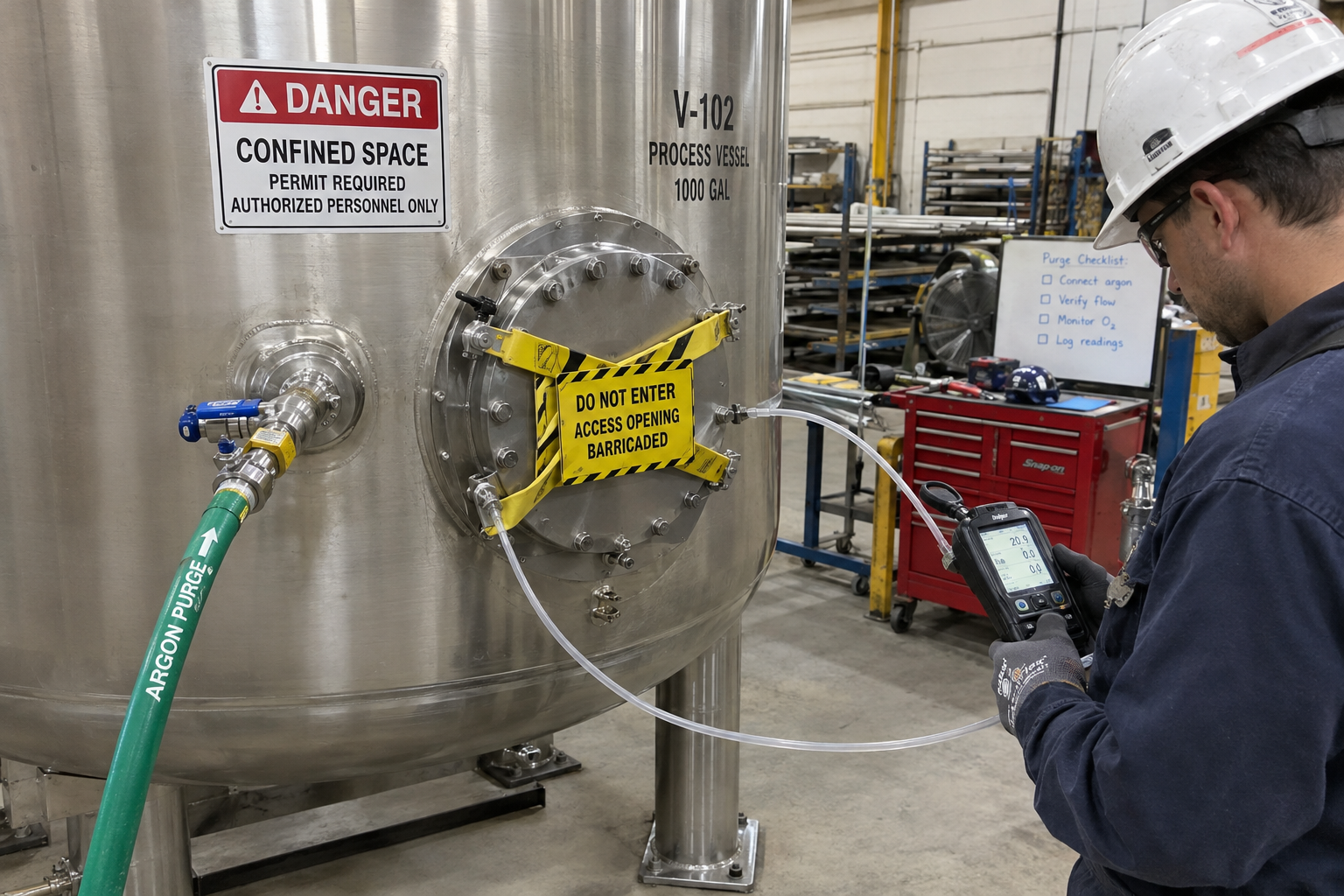
Never put your head inside a purged vessel to inspect the root without proper assessment and controls. Confined-space welding may require isolation, ventilation, atmospheric testing, an entry permit, an attendant, and a planned rescue capability. A monitor must test for the hazards identified; an oxygen reading alone doesn’t establish that the atmosphere is safe. If someone collapses inside, do not enter impulsively and become the second casualty.
7. Make Exposure Control Part of the Job Setup
A useful pre-weld check covers more than tungsten diameter and filler selection. You want the contamination identified, the airflow working, and any required respiratory protection ready before the first tack. Then reassess when the job changes—especially when you move from an open bench into a corner, enclosure, or production run. More arc time can mean more exposure.
- Identify the materials: Include filler, coatings, cleaners, and nearby work.
- Set the airflow: Capture at the source without disrupting shielding or exposing another worker.
- Verify exposure: Use representative personal breathing-zone sampling through a qualified occupational hygienist; assess gases separately where relevant.
- Maintain the controls: Inspect extraction equipment and service filters as specified. Use suitable HEPA vacuuming or wet cleaning rather than blowing deposited dust airborne.
- Respond to symptoms: Stop work and move to fresh air if exposure causes irritation or illness. Seek urgent medical help for breathing difficulty, chest pain, confusion, collapse, or suspected phosgene exposure; serious effects can be delayed.
Tell the medical team what you welded, which coatings or cleaners were involved, and when the exposure occurred. That information is more useful than simply saying you felt bad after work. A clean TIG bead shows that you controlled the puddle. Protecting your lungs takes a separate set of controls.