TIG Welding Art: 7 Stainless Steel Sculpture Techniques
TIG Welding Art: 7 Shop Techniques for Cleaner Seams and Straighter Sculptures
A sculpture can have a sound weld and still look rough because the seam wandered, the sheet pulled, or the grinder flattened a curve you spent an hour forming. TIG welding art puts those small mistakes out where everyone can see them. The fix usually starts before you strike an arc, with tighter joints, a sensible sequence, and a decision about which seams you want visible in the finished art. These seven techniques focus on thin sheet, rod, and small tubing—the material that makes heat control interesting.
1. Fit and Clean the Joint Before You Reach for the Torch
A tight, consistent joint gives you somewhere predictable to put the puddle. For decorative butt joints in 0.040–0.063-inch sheet, aim for near-zero gap unless your joint design specifically requires one. A wandering 1/16-inch gap in that material isn’t artistic freedom; it’s a hole you’ll spend the afternoon chasing. Trim and refit instead of planning to bridge everything with filler. Clean fit-up is one of the foundations of reliable metal art.
Deburr both faces and remove coatings, mill scale, and oxidation about 1/2 inch back from the joint, including the underside. On mild steel, TIG tolerates far less surface contamination than a process that uses flux. On aluminum, degrease first, let the surface dry, then remove oxide with a dedicated stainless-steel brush. Keep separate abrasives and brushes for stainless and aluminum so you aren’t grinding embedded steel particles into your sculpture or TIG art.
- Mild steel: Remove mill scale to bright metal; a shiny high spot surrounded by black scale isn’t clean enough.
- 304L stainless: Remove grease, marker residue, and adhesive from protective film around the joint.
- Aluminum: Use known alloy stock when possible. Unknown castings and scrap can introduce porosity and filler-selection problems.
- Solvents: Never use chlorinated brake cleaner near an arc. Use a suitable nonchlorinated cleaner, follow its safety instructions, and let it evaporate completely.
2. Set Up for Thin Metal, Not Maximum Machine Output
Use DC electrode negative for mild steel and stainless, and normally AC for aluminum. A 1/16-inch, 2% lanthanated tungsten is a practical starting point for low-current DC sculpture work; a 3/32-inch tungsten gives you more room on higher-current aluminum joints. Grind longitudinally on a dedicated wheel and follow your machine’s electrode-preparation recommendations for AC. A contaminated tip makes the arc wander, and no amount of pedal finesse fixes that.
Starting Settings for TIG Welding Art Coupons
These are approximate pedal-controlled peak-current settings for short joints, not fixed travel-current requirements. Test them on offcuts with the same thickness, fit-up, and backing as the sculpture. Outside corners generally need less current than fillets or joints attached to a heavy base. The pedal should give you useful control, not cram the entire working range into the first twitch of your ankle. A coupon tells you more about a planned piece of welding art than a setting copied from a chart.
| Material and thickness | Starting peak current | Filler starting point |
|---|---|---|
| Mild steel, 0.048–0.063 inch | DCEN, 45–80 A | ER70S-2, 0.045 or 1/16 inch |
| 304L stainless, 0.048–0.063 inch | DCEN, 35–65 A | ER308L, 0.035 or 0.045 inch |
| 6061 aluminum, 0.063 inch | AC, 65–100 A | ER4043, 1/16 inch, subject to service requirements |
For inverter AC on aluminum, try 80–120 Hz and about 65–75% electrode negative as an initial setup. Check the manual because some machines display electrode-positive cleaning percentage instead. Increase cleaning action only as needed on properly prepared metal; excessive electrode positive heats the tungsten and sacrifices penetration. If the sculpture will be anodized, settle the alloy and filler combination first because ER4043 beads can finish noticeably darker. That color difference can matter when the weld is part of the art.
3. Improve Shielding Instead of Cranking Up the Argon
A gas lens straightens the shielding flow and helps you reach around sculpted shapes without immediately losing coverage. With 100% argon and a #6–#8 cup indoors, roughly 12–18 CFH is a reasonable starting range. Start with about 1/8–3/16 inch of tungsten extension beyond the cup, then extend only as access requires and coupon testing supports. More flow isn’t automatically better because turbulence can pull air into the shield.
Keep the torch roughly 10–15 degrees off perpendicular and block drafts without trapping fumes around your face. If stainless beads turn dull gray or crusty, check coverage, torch angle, leaks, and heat input before buying a bigger cup. Set postflow long enough to protect the hot tungsten and crater—often 5–10 seconds at these currents—and keep the cup over the termination. Don’t finish a nice bead and immediately whip the torch away. Clean shielding helps the weld look intentional, which is important in visible TIG art.
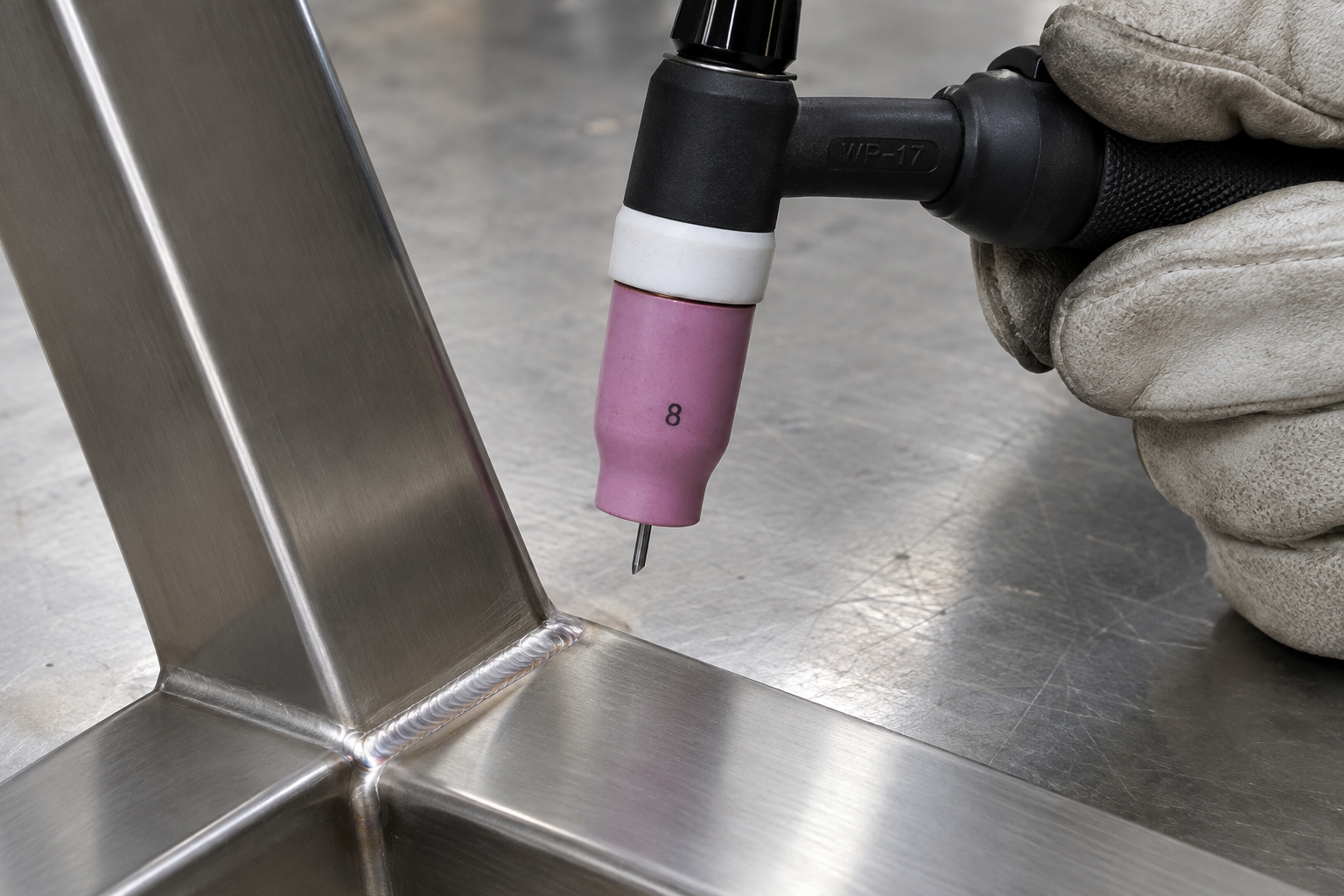
When a stainless joint penetrates through to the back, shield that root with a suitable argon purge if you need a clean backside. Otherwise, heavy root oxidation—sugaring—can spoil both appearance and corrosion resistance. Purge setups need an outlet, and hollow sculptures need a planned vent so you never heat or join a sealed volume. Argon also displaces oxygen, so keep purge work ventilated and out of confined spaces. The backside may not be visible in the finished art, but it still affects the joint.
4. Tack the Whole Shape and Make Shrinkage Work Against Itself
A 30-by-30-inch stainless frame can measure square before joining and finish with one corner lifted off the table. Every cooling bead contracts, so completing one side before touching the opposite side stacks the movement in one direction. Assemble and tack the entire shape before committing to finish passes. Then check diagonals, curves, and the base contact points while corrections are still manageable. In sculpture art, shape control matters just as much as bead appearance.
- For thin sheet edges, try small tacks approximately 1–2 inches apart, tightening the spacing where the joint opens or buckles.
- Place opposing tacks rather than marching continuously around the perimeter.
- Finish in short, alternating sections—often 1/2–1 inch on delicate assemblies—and move to a distant joint between sections.
- Pause when successive sections begin with the surrounding metal already hot; longer cooling breaks may be necessary.
Copper or aluminum backing can support a thin edge and pull away heat, provided the shape lets it sit flat. Keep the arc off the backing and recognize that a heavily chilled joint may need different settings from an unsupported one. Clamps help, but forcing every surface rigidly flat can store stresses that appear when you release it. Let the assembly cool before unclamping and measuring; hot measurements can fool you.
5. Control the Puddle with Arc Length and Small Filler Additions
A short arc makes a narrower, more controllable puddle than a long arc at the same current setting. On thin DC steel or stainless work, aim for roughly 1–2 mm between the tungsten tip and puddle when access allows. Keep your torch hand supported and reposition before your wrist runs out of travel. Stretching through the final inch usually changes the angle, arc length, and bead width all at once. That small loss of control shows quickly on visible welding art.
Establish a puddle that wets both edges, then add a small amount of filler at its leading edge. Keep the hot rod tip inside the shielding envelope between dabs instead of pulling it far back into air. Oversized filler chills a tiny puddle, so you add current to recover and suddenly the surrounding sheet is getting too hot. Thin wire earns its place here.
For a thick rod joined onto a thin leaf, bias the arc toward the rod and wash the puddle onto the sheet. Don’t park the arc on the leaf and wait for the rod to catch up. Tight, noncritical decorative edges can sometimes be fused without filler, but don’t assume a pretty fusion line provides adequate strength for handles, bases, or suspended pieces. At the stop, taper current and add enough filler to avoid leaving a crater. A clean stop is part of the finished art, not just a machine setting.
6. Use Pulse and Bead Rhythm as Deliberate Design Tools
Pulse TIG can help separate the moment you establish fusion from the moment you move or add filler. For a visible, spaced ripple on thin stainless, try 1–2 pulses per second, 25–40% background current, and 30–50% peak time. Add filler during the peak and move consistently through the lower-current portion. Those are coupon settings, not a promise of penetration. Use them to test the bead pattern before you commit it to the sculpture art.
Choose a Visible Bead or a Nearly Invisible Seam
For a smoother-looking seam, try 30–100 pulses per second and maintain steady travel rather than trying to dab on every pulse. With an idealized square pulse at 60 A peak, 30% background gives 18 A background; at 40% peak time, average current is about 35 A. That arithmetic helps compare settings, but actual heat input also depends on arc voltage, waveform, and travel speed. Pulse doesn’t automatically run cooler if you slow down to admire it.
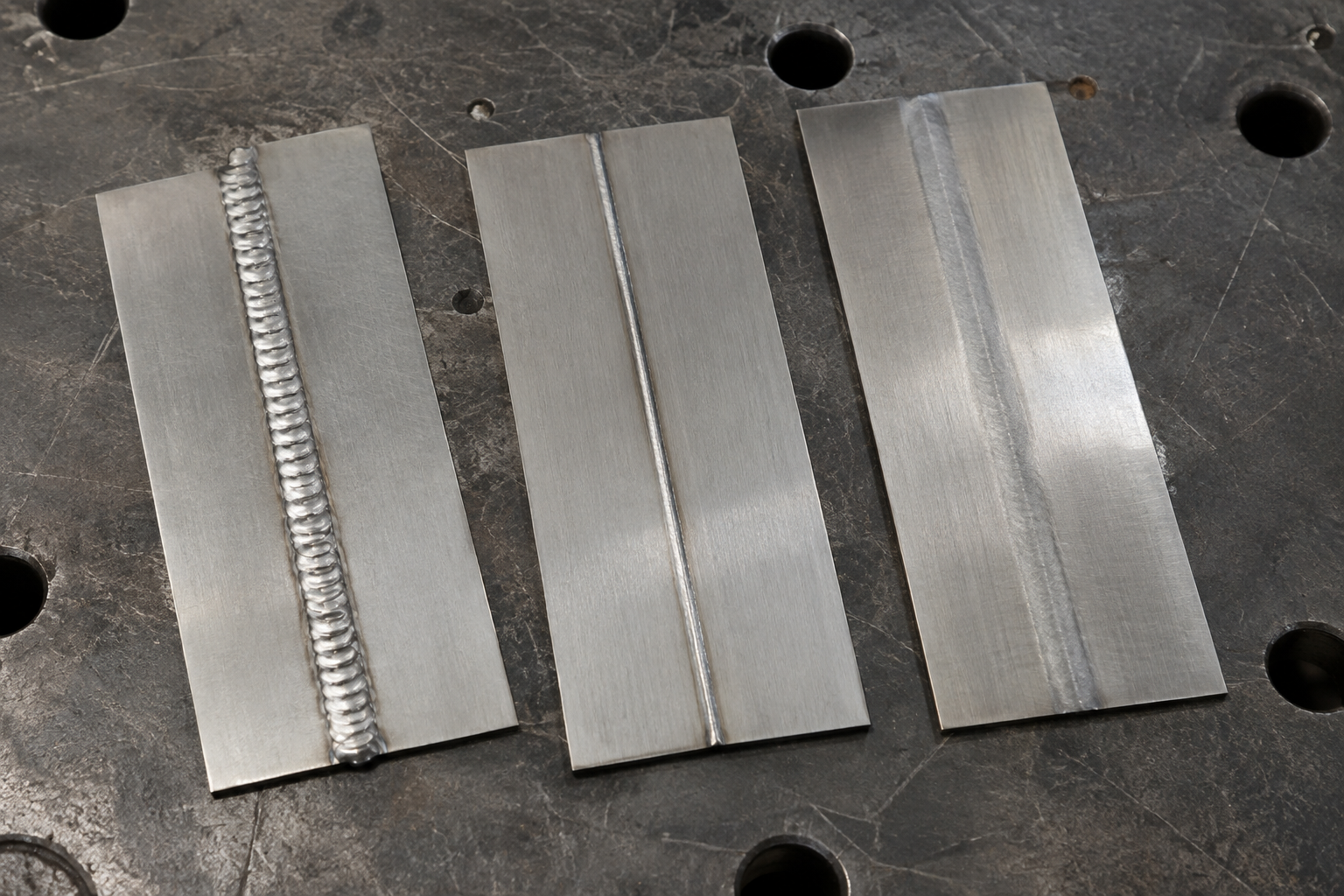
If the bead is part of the artwork, repeat its width, spacing, and direction across the piece. If the seam will disappear, prioritize complete fusion and modest reinforcement rather than a tall stack of filler you must grind away. Stainless heat tint isn’t a dependable outdoor finish, either, and heavy oxidation needs attention. Make the decorative choice deliberately, whether you want a visible TIG art bead or a nearly invisible seam.
7. Blend the Weld Without Grinding Away the Sculpture
Grinding should refine a sound joint, not hide undercut, porosity, or incomplete fusion. Mark the intended contour before dressing a seam, then remove only the reinforcement that interferes with that shape. A hard wheel can flatten a curved petal in seconds, so small abrasives and light pressure often give you more control. Once you grind below the parent surface, you’ve created a repair.
- Blended steel seams: Start around 80 grit where practical, then progress through 120 and 180–240 grit to suit the finish. Coarser abrasives belong on heavier excess, not fragile sheet edges.
- Brushed stainless: Blend scratches in the surrounding grain direction using iron-free, stainless-dedicated abrasives.
- Corrosion-resistant stainless: Remove heat tint and the affected surface using an appropriate qualified process. Passivation alone doesn’t remove heavy oxide scale.
- Painted mild steel: Remove contamination and prepare for primer promptly; bare steel can flash-rust before you notice.
Use eye, hearing, and appropriate respiratory protection for finishing, and capture grinding dust and fumes at the source without disrupting shielding. Stainless pickling products can contain extremely hazardous acids, so professional treatment may be the sensible choice. Finally, inspect under low-angle light, check stability, and feel for sharp edges only after the piece is cool and safely deburred. Cleaner TIG welding art comes from controlled decisions—and fewer repairs disguised as finishing.