Best Budget TIG Welders 2025: 3 AC/DC Picks Under $1000 That Can Weld Aluminum
Best Budget TIG Machines 2025: 3 AC/DC Picks Under $1000 for Aluminum
A low-cost TIG machine stops being a bargain if you buy a DC-only model and then find out it cannot run conventional AC TIG on aluminum. For this 2025 shortlist, I’d narrow the shopping to the PrimeWeld TIG225X, AHP AlphaTIG 203Xi, and YESWELDER TIG-200P AC/DC. They cover the useful end of the budget market: steel brackets, stainless tubing, and aluminum work that needs cleaning action and controllable heat.
This is a specification-based buying guide, not a claim that I’ve run all three machines side by side. The prices below are approximate U.S. shopping ranges, not verified historical sale quotes, and package contents matter as much as the number on the listing. The $1000 ceiling applies to the machine package—not a complete fabrication station.
1. Compare the Package, Output, and Controls Before the Price
For general shop work, I’d look for AC/DC TIG, high-frequency starting, pedal control, adjustable AC balance, and enough output on 240V to handle 1/8-inch aluminum without living at the machine’s limit. Pulse is useful, but it comes after those basics. A comfortable torch and predictable pedal are worth more than another page of waveform settings you won’t use. Especially while you’re learning.
| Welder | Approximate shopping range | Maximum TIG output on 240V | Main distinction | Best fit |
|---|---|---|---|---|
| PrimeWeld TIG225X | $869–$999 | 225A | Extra output and a commonly supplied CK Worldwide torch package | Mixed steel and aluminum work from a fixed shop bench |
| AHP AlphaTIG 203Xi | $750–$900 | 200A | Guided setup alongside adjustable TIG parameters | A developing TIG welder who wants help getting started |
| YESWELDER TIG-200P AC/DC | $600–$850 | 200A | Lower purchase price when the package is complete | Occasional fabrication where savings can fund gas and consumables |
All three are dual-voltage machines, but their headline output belongs to the higher-voltage supply. Don’t assume a 120V receptacle gives you the same aluminum capability. Also, match the exact model and revision: a similarly named DC TIG machine, torch-trigger package, or newer “Pro” version isn’t automatically the machine being compared here.
2. PrimeWeld TIG225X: Best Package for a Fixed Shop Bench
The TIG225X gets my first look because its 225A ceiling gives you a little more room on aluminum, and the commonly advertised package includes a CK Worldwide air-cooled torch and foot pedal. That torch matters because a stiff cable keeps pulling against your hand while you’re trying to hold a short arc. You can replace a poor torch later, but then your bargain starts getting expensive. I’d rather buy the usable package first.
- Output: Up to 225A on 240V, with reduced output on 120V.
- Controls: Dedicated knobs for parameters including AC balance, AC frequency, and pulse.
- Portability: Roughly 41 pounds for the power source; portable, but not something I’d choose for repeated ladder trips.
- Buying check: Confirm the CK torch, pedal, regulator, warranty terms, and delivered price on the actual listing.
The front panel can look busy, but separate knobs let you see what’s set without stepping through a menu. I prefer that at a bench, although someone who wants guided setup may prefer the AHP. The extra 25 amps won’t turn it into a production machine for thick aluminum, and extended high-current work can outgrow an air-cooled torch. That’s a separate limit from the power source’s duty cycle.
Verdict: Buy the TIG225X if you have 240V, expect to work with aluminum regularly, and want to avoid immediate torch upgrades. It’s the strongest package-first recommendation here when it lands comfortably below $1000.
3. AHP AlphaTIG 203Xi: Best for Learning Without Losing Adjustment
The AlphaTIG 203Xi makes sense for someone who understands the joint they want to make but still needs help getting the machine into the neighborhood. Its guided setup is the useful distinction—not simply another claim of 200 amps. You still need access to AC balance, frequency, and pulse as your control improves. Presets should get the puddle started, not do your thinking for you.
- Output: A 200A-class AC/DC machine on 240V, with lower available output on 120V.
- Ease of use: Guided setup reduces the number of initial decisions for a beginner.
- Practical workload: Steel fabrication and occasional aluminum joints around 1/16 to 1/8 inch.
- Buying check: Verify the 203Xi model designation, included pedal, torch configuration, and current manual.
The limitation is that material thickness alone doesn’t determine amperage. A 1/8-inch aluminum outside corner and a 1/8-inch fillet attached to a large plate can need quite different pedal input because the larger assembly pulls heat away. Use the suggested setting, watch how quickly the puddle forms, and adjust. Sitting there warming the whole part while the joint refuses to wet out isn’t helping.
Verdict: Choose the AHP if setup assistance will help you practice more effectively and its complete package costs less than the PrimeWeld. If the delivered prices are almost identical, compare the torch, pedal, and service arrangements before deciding.
4. YESWELDER TIG-200P AC/DC: Best Lower-Cost Entry, With Package Checks
The YESWELDER TIG-200P AC/DC belongs here because leaving money for argon is more useful than owning a better-equipped machine you can’t afford to run. Its AC/DC capability and adjustable TIG functions cover ordinary hobby fabrication without demanding the full $1000 allowance. The issue is the listing: similarly named machines and different accessory bundles make a quick price comparison unreliable. Read past the large “200A” graphic.
- Output: Up to 200A on the appropriate higher-voltage supply.
- Controls: Look for the specified AC balance, AC frequency, pulse, and remote-current functions on the exact revision.
- Package risk: Confirm whether a compatible variable-current pedal is included, rather than assuming a torch switch provides equivalent control.
- Ownership check: Price a replacement pedal and torch, and find out who handles warranty shipping.
I wouldn’t rank internal build quality from a case photograph or a specification sheet. What you can assess before buying is connector compatibility, replacement accessory availability, the manual, and the return process. A proprietary pedal connector isn’t automatically a problem, but discovering that replacements are unavailable certainly is. Cheap downtime is still downtime.
Verdict: Buy this model for occasional work when the complete, pedal-equipped package saves roughly $200 or more against the other two. If accessories erase that saving, its main advantage disappears.
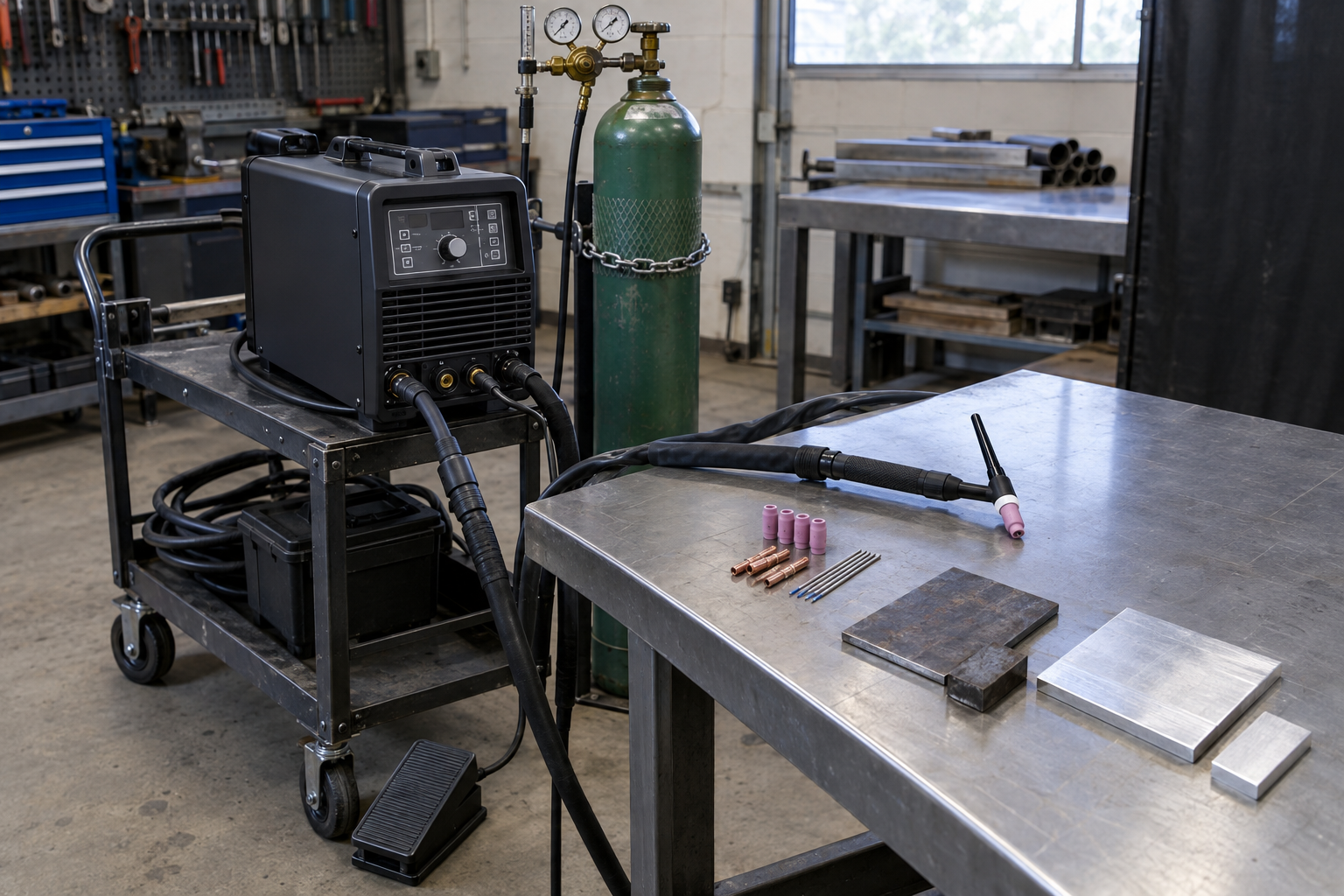
5. Amperage and Duty Cycle: What These Machines Can Realistically Handle
A 200–225A AC/DC inverter is a sensible size for small-shop steel and aluminum, but thickness claims need context. Steel around 1/16–1/8 inch is comfortably within its general working range, while thicker joints may need preparation and multiple passes. Aluminum around 1/8 inch is a realistic target on 240V; 3/16-inch work depends much more on joint shape, assembly size, and heat management. Don’t buy one expecting effortless, continuous 1/4-inch aluminum fillets.
Duty cycle describes allowable arc time under specified test conditions, not overall machine quality. A 40% rating at a stated current means four minutes of operation in a ten-minute period, followed by the prescribed cooling interval; it doesn’t mean four minutes at every setting. Compare the current, ambient temperature, and supply voltage behind each rating in the exact model’s manual. A percentage without those conditions isn’t much of a comparison.
- Short brackets and practice coupons: Fit-up, brushing, and repositioning often provide substantial cooling time.
- Long aluminum seams: Power-source duty cycle and torch heating become real production limits.
- 120V operation: Useful for lighter work, but check the specified input current and circuit requirements.
- 240V installation: Follow the manual and applicable electrical code; a plug adapter does not increase circuit capacity.
6. Starting Settings for Steel and Aluminum
Start with clean coupons and ordinary settings before experimenting with pulse. That lets you separate a machine-control problem from dirty material, poor shielding, or excessive arc length. Use 100% argon, keep the work out of drafts, and check for leaks. Turning the flowmeter way up can create turbulent shielding rather than fix it.
Mild steel: DC electrode negative
For a 1/8-inch mild-steel practice joint, set a pedal-controlled maximum around 125–150A and adjust for the joint and travel speed. A sharpened 3/32-inch, 2% lanthanated tungsten and ER70S-2 filler are sensible starting choices. Remove mill scale to bright metal in the weld area, and start around 15–20 CFH through a #7 or #8 gas-lens cup indoors. Hold a short arc without dipping the tungsten into the puddle.
Aluminum: AC with controlled cleaning action
For clean 1/8-inch 6061 practice pieces, start with a maximum around 160–180A, AC frequency around 80–120 Hz, and roughly 65–75% electrode negative. Check the balance convention first: a display showing cleaning percentage generally refers to electrode-positive time, so the corresponding number runs the other way. More electrode positive increases cleaning but also puts more heat into the tungsten. Don’t use excessive cleaning action to compensate for dirty plate.
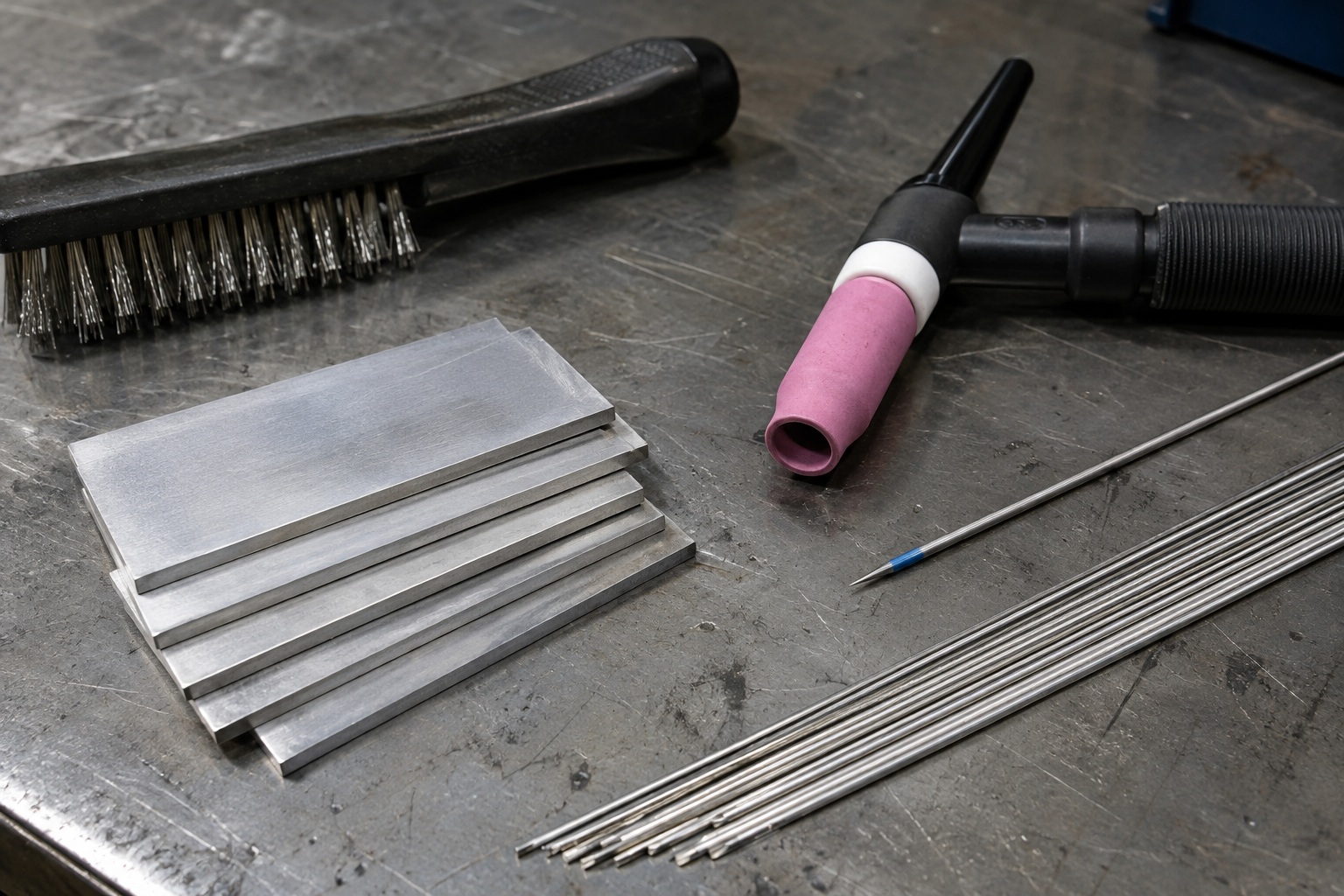
Use filler appropriate to the base alloy and service requirements; 4043 is a common choice for ordinary 6061 practice joints, not a universal aluminum filler. Degrease with a suitable nonchlorinated cleaner and let it evaporate fully before brushing and working. Follow the tungsten preparation guidance for the inverter rather than deliberately making a large ball. Then back off the pedal as the part heats up.
7. Which Budget AC/DC TIG Welder Should You Buy?
I’d put the PrimeWeld TIG225X first for a permanent shop setup, the AHP AlphaTIG 203Xi first for guided learning, and the YESWELDER first only when its complete package delivers a meaningful saving. None of those verdicts depends on a pulse-frequency headline. They depend on what you’ll hold, adjust, power, and eventually replace. That’s where budget equipment either earns its keep or gets annoying.
If you’re starting from nothing, allow several hundred dollars beyond the machine for an argon cylinder arrangement, gas, protective equipment, tungsten, filler, and consumables; local cylinder costs vary considerably. For a genuinely firm $1000 total budget, the lowest-priced complete package may be the only workable route, and even that needs careful arithmetic. Buy around your usual joint and available electrical supply—not the thickest plate in the advertisement.