Best Tungsten Grinder for TIG Welding: 4 Setups, $100 to $3,000+
Best Tungsten Grinder for TIG Welding: 4 Setups, $100 to $3,000+
The best tungsten grinder for TIG welding isn’t necessarily the one that makes the sharpest needle. It’s the one that gives you the same usable point every time, without contaminating the electrode or throwing grinding dust around your breathing zone. A dedicated bench setup can handle occasional repairs, but guided dry grinders and wet machines start making sense when you’re sharpening a handful of electrodes before every shift.
Compare Total Cost, Point Repeatability, and Dust Capture
I’d judge a tungsten sharpening setup by three things: what it costs ready to use, whether it repeats your chosen geometry, and where the dust actually goes. Portability matters for field work, while grinding speed matters more at a shared sharpening station. Motor power alone tells you very little; a stable guide and an accessible, reasonably priced diamond wheel usually matter more.
The prices below are broad equipment-budget estimates in US dollars, not current quotes for particular products. Wheel replacements, diameter guides, extraction equipment, and taxes can change the total substantially. A cheap open grinder and a dust-controlled sharpening station are not the same purchase.
| Setup | Approximate equipment cost | Point repeatability | Dust control | Best fit |
|---|---|---|---|---|
| Dedicated bench grinder with suitable diamond wheel | $100–$350; extraction extra | Operator-dependent; better with a fixture | Poor unless properly captured at source | Occasional sharpening at a fixed bench |
| Rotary tool with tungsten grinding guide | $80–$250 complete; extraction extra | Fair to good with a rigid, accurate guide | Usually limited; varies by enclosure | Portable work and light fabrication |
| Purpose-built enclosed dry grinder | $300–$1,500+; filtration may be extra | Good to excellent with sound guides | Good only with effective collection or extraction | Daily TIG work and shared stations |
| Wet tungsten grinder | $900–$3,000+ | Good to excellent | Strong source suppression; slurry requires handling | Higher-volume and controlled indoor work |
1. Dedicated Bench Grinder: Lowest Entry Cost, Highest Operator Dependence
A dedicated bench grinder makes sense if you already have bench space and only prepare a few electrodes at a time. Use a diamond wheel intended for tungsten sharpening, compatible with the grinder’s speed, mounting arrangement, and guards. Keep that wheel for tungsten only, because a wheel used on mild steel can transfer unwanted material onto the electrode you’re trying to clean up.
The issue is repeatability. Freehand grinding can produce a serviceable point, but maintaining the same included angle and keeping the tip centered takes practice, especially with 1/16-inch electrodes. A rigid angle fixture helps, provided it lets you rotate the electrode smoothly and presents the tungsten so the grinding scratches run lengthwise.
- Precision check: Look for a centered point, an even taper, and no chatter marks.
- Build-quality check: The wheel should run true, and the rest or fixture shouldn’t move under light pressure.
- Safety check: Grind only on the wheel surface approved by its manufacturer; don’t side-load a wheel designed for peripheral grinding.
Verdict: This is the budget choice for occasional work where you can provide proper guarding and source capture. I wouldn’t call an open bench grinder the best value for an occupied indoor shop until the dust-control cost is included. Cheap sharpening gets less attractive when cleanup becomes everybody else’s problem.
2. Rotary Tool and Guide: Best for Portability, With Some Compromises
A rotary-tool tungsten sharpener puts a small diamond wheel behind a guide with diameter holes and fixed or adjustable angles. It packs easily, and that matters when the welding machine, torch accessories, and extension leads already fill the cart. For light work using 1/16- and 3/32-inch tungsten, a well-made guide can be much more consistent than freehand sharpening.
Check what the angle markings actually mean before buying. One guide may label the angle between the electrode axis and the grinding surface, while another advertises the finished included tip angle. Also inspect the grinding geometry: a hole marked “30°” doesn’t guarantee lengthwise grinding marks or a centered point.
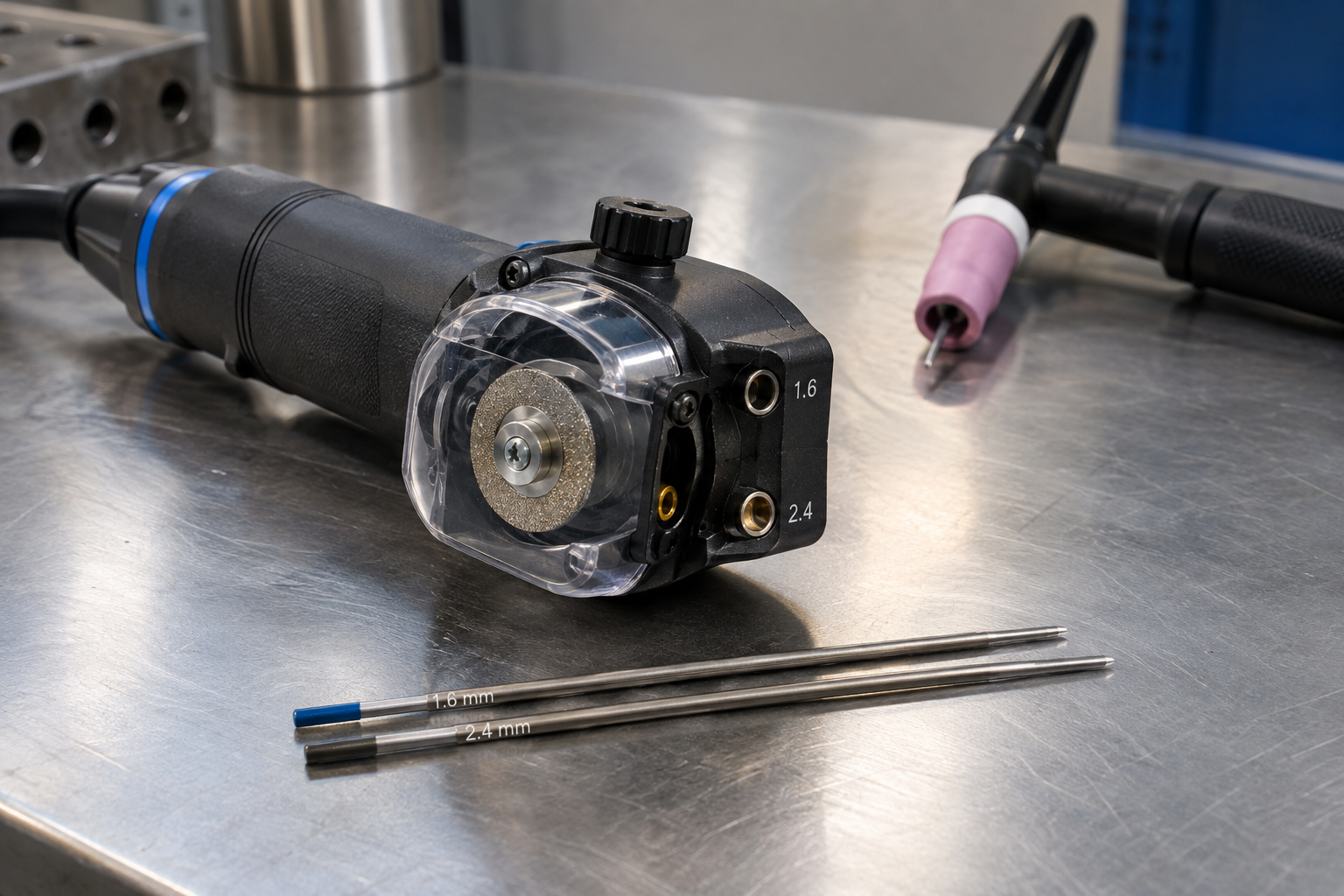
Small wheels can wear a groove quickly if the guide always tracks over the same spot. Loose threads, worn guide holes, and spindle runout also show up as an off-center point, so replacement parts matter more than a bag full of accessories. An enclosed-looking attachment may still vent fine dust straight through its electrode openings.
Verdict: Choose this setup for portable repairs and modest sharpening volume, especially if you already own a compatible rotary tool. I’d pass on it as the main station for several welders preparing electrodes throughout the day. Tiny guides and tiny wheels have their place, but production sharpening isn’t usually it.
3. Enclosed Dry Tungsten Grinder: Best Balance for Daily TIG Work
A purpose-built dry grinder earns its money through guidance and convenience, not by doing something magical to tungsten. Better units support the electrode close to the wheel, provide repeatable angle adjustment, and let you use different wheel tracks as the abrasive wears. Some also include tip flattening and enclosed cutoff features, which are useful after a proper dip into the puddle.
For daily work on 304L stainless or mild steel with a 3/32-inch electrode, I’d prioritize a solid guide, clear angle settings, and effective dust collection over extreme compactness. Check whether 1/16-, 3/32-, and 1/8-inch guides are included or sold separately. If you use short electrodes in a back-cap-limited torch, verify the minimum grindable length with the specified holder.
- Look for: Replaceable guides, available diamond wheels, and a housing that opens for controlled servicing.
- Ask about: Continuous-use limits, thermal protection, and approved extraction requirements.
- Don’t assume: A dust drawer captures the fine particles that stay airborne.
Verdict: An enclosed dry grinder with effective collection is my default recommendation for a regular TIG bench. It gives you repeatability without adding coolant and slurry maintenance. For several users, easy setup and durable guides can save more aggravation than a slightly faster motor.
4. Wet Tungsten Grinder: Best Dust Suppression, Highest Upkeep
A wet tungsten grinder uses liquid around the grinding interface to suppress dust and carry grinding residue into the machine. That makes it attractive for frequent indoor electrode preparation, especially where an open dry process would require substantial extraction work. The liquid also carries away heat, although you still need light pressure and correct electrode support.
The tradeoff is maintenance rather than grinding quality. You’ll need the specified grinding fluid, a sensible cleaning schedule, and a way to collect and dispose of contaminated liquid and sediment. Letting the reservoir turn into thick sludge doesn’t improve anything, and it can make an expensive machine unpleasant to service.
Compare angle range, electrode diameter capacity, and minimum electrode length before paying for the wet system. Check whether cutoff and flattening are included, because sharpening a clean electrode and removing a contaminated end are different jobs. Also consider machine placement: this is usually a fixed station, not something you want bouncing around loose in a service truck.
Verdict: Choose wet grinding when frequent sharpening and source dust suppression justify the purchase and servicing. It’s usually excessive for someone welding twice a month. For a busy indoor TIG operation, it deserves a serious look.
Dial In Tungsten Geometry Before Blaming the Grinder
A repeatable point is only useful if it suits the welding conditions. For DCEN work on roughly 0.060–0.125-inch steel or stainless, a 3/32-inch lanthanated electrode with a 30–60° included point and a small flat is a reasonable starting area, not a universal prescription. Joint design, roughly 50–150 amps of welding current, shielding, and arc length all affect what works best.
Separate Included Angle, Taper Length, and Tip Flat
The included angle is the full angle across the point, not the angle on one side. Before adding a flat, a 3/32-inch electrode with a 30° included point has a taper approximately 0.175 inch long; at 60°, it’s approximately 0.081 inch. That’s why “grind it two diameters long” and “use a 60° point” are not interchangeable instructions.
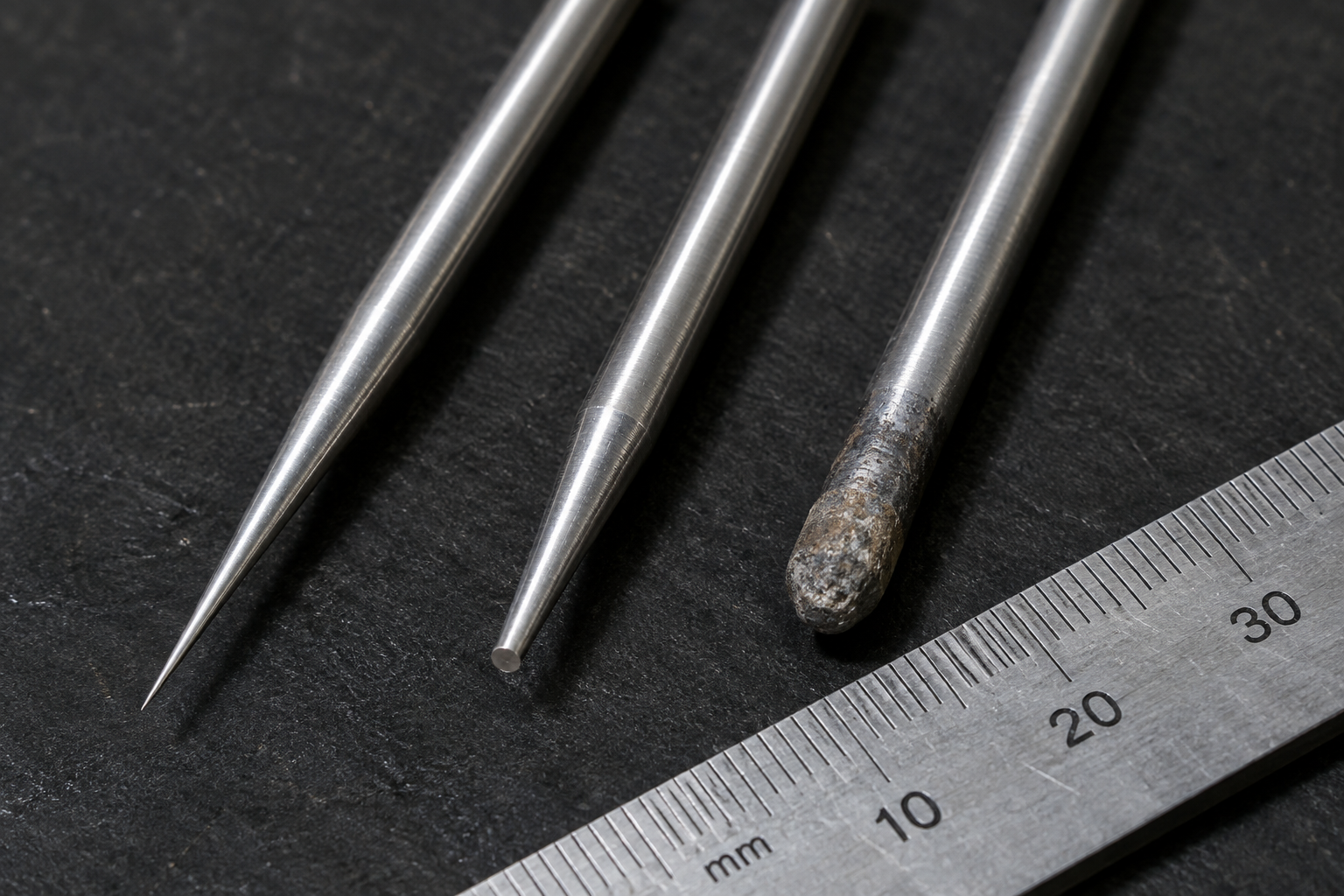
- Remove contamination first. Use a suitable dedicated cutoff method to remove the affected end; don’t just polish deposited metal into a point.
- Grind lengthwise. Orient the electrode so abrasive travel leaves scratches along the taper, and rotate it smoothly to keep the point centered.
- Use light pressure. Forcing the electrode encourages heat, wheel wear, and uneven removal.
- Add a controlled flat. Approximately 0.010–0.020 inch is a useful starting range for many moderate-current applications using 3/32-inch tungsten; adjust to the electrode and procedure.
On inverter AC aluminum, follow the machine and electrode manufacturer’s preparation guidance rather than automatically forming a large ball. A truncated point is common with suitable alloyed tungsten, but current and electrode-positive balance affect how that end changes during welding. More electrode-positive time puts more heat into the tungsten, and a needle that survives low-current DC may not survive that setup.
Dust Control and Consumables Decide the Real Buying Value
All tungsten grinding dust deserves control, and thoriated tungsten adds a radioactive-material concern. Prefer a suitable non-thoriated electrode where your welding procedure allows it, but don’t treat lanthanated or ceriated dust as harmless. Capture dust at the source, avoid compressed-air cleaning and dry sweeping, and follow the electrode safety data sheet and workplace exposure requirements.
For dry collection, use equipment specifically suitable for the dust and application rather than assuming a household vacuum with a filter is adequate. An enclosure needs effective capture, sealed handling, and a maintenance method that doesn’t release everything you collected. Wet grinding residue also needs controlled disposal, particularly with thoriated electrodes; don’t pour the slurry down a drain.
Before buying, price one replacement wheel, the guides you actually need, and a year’s worth of filters or grinding fluid. My recommendation is straightforward: dedicated bench grinding for occasional fixed-shop use with source capture, a rotary guide for portability, enclosed dry grinding for daily convenience, and wet grinding for frequent work where dust suppression carries more weight. Buy the setup that repeats your point and contains the waste—not the one that makes the prettiest spark.